
The Association of Ancient Historians
1974-2024
Celebrating 50 years of North America's preeminent scholarly association for historians of the ancient Mediterranean world

This website celebrates 50 years from the constitution of the AAH at Harvard in 1974. It charts the development of the pre-eminent professional organization for historians of the ancient Mediterranean world, and it shows why the AAH continues to be a crucial resource 50 years later for the members of our field.
"The Purpose of the Association shall be to further the teaching of, and research in, Ancient History especially in Canada and the U.S.A., in cooperation with the American Historical Association, the Society for Classical Studies, the Classical Association of Canada, and other societies to which this field is of interest. Ancient History, for the purpose of this Association, shall be defined as the history of the ancient Mediterranean world and the history of other countries in their relations with it."

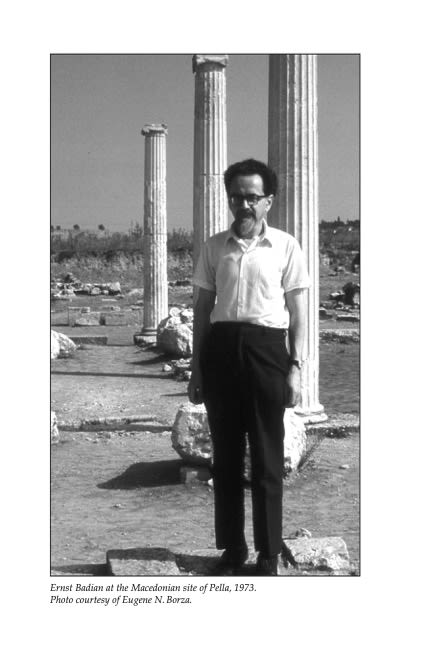
Image reproduced in The Legacy of Ancient Historians, edited by Carol G. Thomas and T. Corey Brennan (Association of Ancient Historians, 2013), v.
"Early in his own career Ernst recognized the value of drawing people of common interests together in a brief but concentrated environment of serious scholarship and equally serious comradeship. The outcome was the creation of the Association of Ancient Historians...One of [Badian's] letters stated “I have no official standing and needn’t be consulted at all (except for my long-continued interest in this”). That “continued interest” moved the AAH forward steadily.
-Carol G. Thomas, "Ernst Badian and the Association of Ancient Historians," in The Legacy of Ancient Historians, edited by Carol G. Thomas and T. Corey Brennan (Association of Ancient Historians, 2013), 1-4.
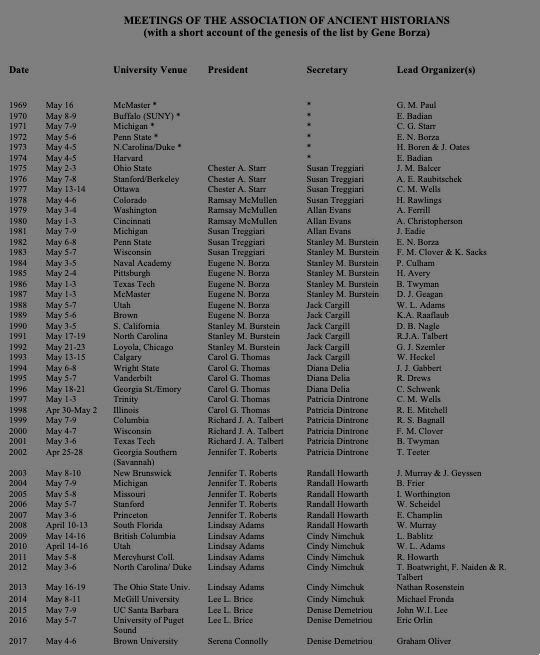
The AAH developed from an informal series of lectures and regional meetings of ancient historians in the years 1969-1973.
Eugene N. Borza, AAH President 1984-89, served for many years as archivist of the AAH. He revealed its origins in a "secret history" at the 1994 meeting, Dayton, OH, 7 May 1994.
"We begin with the proto-history of the Association. Ernst Badian is Theseus, if that is the correct word for "Founder." Some of you will recall that he and Togo Salmon and Salmon's colleagues at McMaster University held a small regional meeting of ancient historians in 1969. Not long after, in late May of that year, Badian accepted an invitation to present a lecture and seminar at Penn State.
During the course of his visit we sat in my back yard having drinks, and he spoke about the informal ancient history meetings he had organized at Leeds, and again at McMaster. He asked my opinion about extending the meeting to encompass a larger geographical area for a 1970 conference at Buffalo. He emphasized a high quality of papers and discussion, informality, and equal parts of the academic and social."
The Buffalo meeting was followed by regional meetings at Michigan, Penn State, University of North Carolina and Duke, with another planned for Harvard in 1974. Shortly before the Harvard meeting, Badian wrote:
"I have come to think we ought, perhaps after all, to form an Ancient Historians' Society (under whatever name) at the May meeting... One could avoid bureaucracy and self-importance by proceeding in practice just as we have hitherto."
The AAH took inspiration from similar scholarly groups in Europe and sought to define itself in response to larger professional organizations in North America.
The newly constituted AAH had officers, a growing membership, and a newsletter.
Ernst Badian now sought to put the AAH on a sound organizational footing.

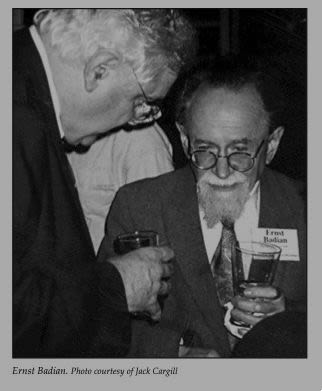
Ernst Badian and the founding members created a constitution for the AAH that would reflect their ideals for a scholarly association. It remains a highly effective document fifty years later.
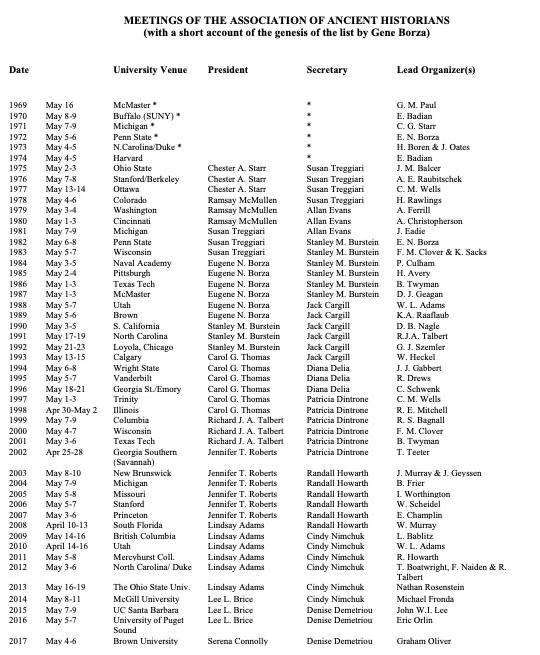
Over the last 50 years, 12 people have served as President, 11 as Secretary and/or Treasurer.
There have been 5 women in each role.



The AAH serves all persons with an interest in the study of the ancient Mediterranean world, with memberships available to faculty, graduate students, and supporters of ancient history.
In 1974, the AAH had 94 members; in 2024, it has over 650.
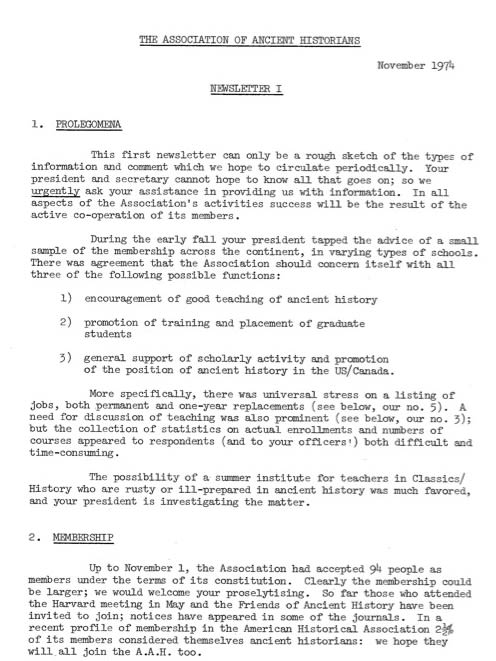
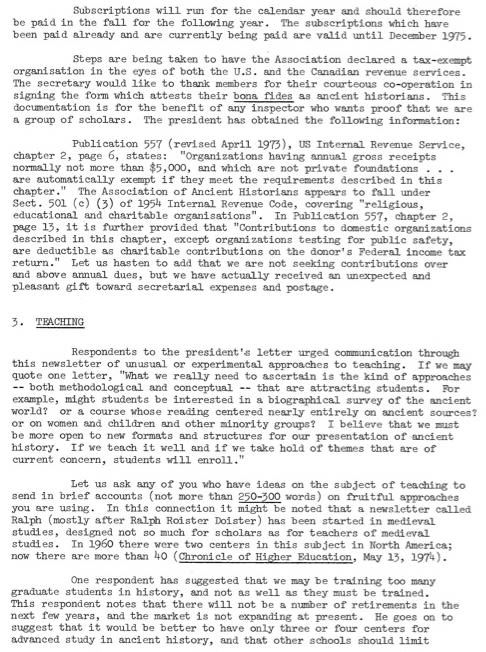
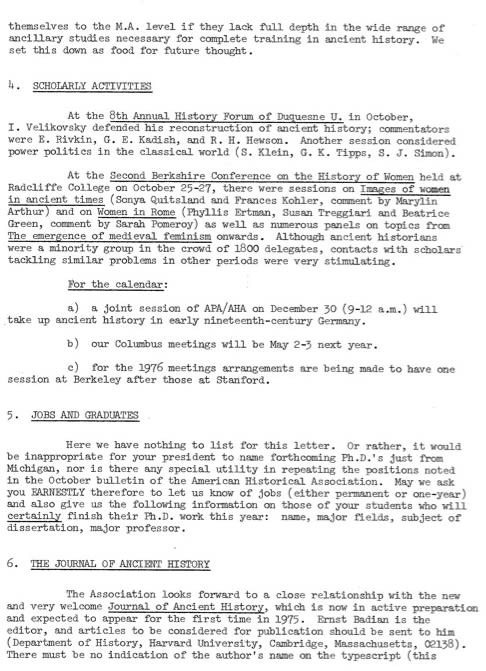
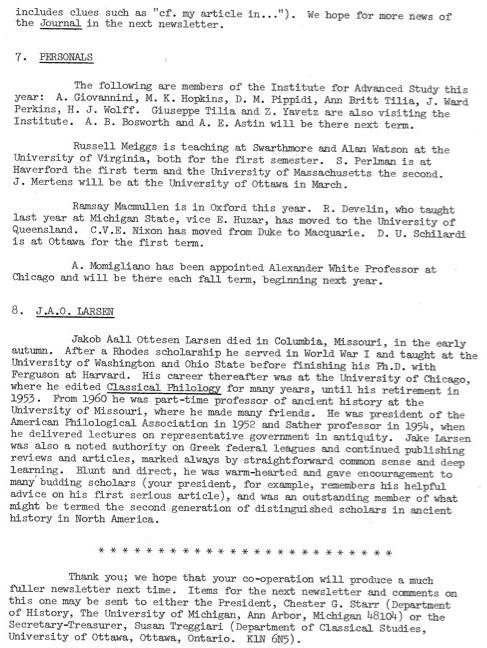
Through 140 (and counting) newsletters, we can track topics that have held the attention of the AAH and its members. Some have not changed: as an early newsletter reveals (see "3. Teaching," at right), anxieties over placement of graduate students and the size of the field have not changed in our 50 years.




The annual meeting of the AAH is unique: every session is plenary, enabling attendees to hear and comment on all the papers; we are hosted by AAH members at their home institutions, making every meeting different; and we promote collegiality, encouraging people active in our field in every possible way to take from and contribute to the meetings.

Susan Treggiari, the first AAH Secretary-Treasurer (1975-1978), subsequently President (1981 -1983), details her experience at AAH meetings.
Susan Treggiari reflects on the most appealing parts of the meetings.
"Excitement, looking forward to the meeting, anticipating bumping into people you like, and you know, meeting other people that you don't know. It's a meeting one wanted to go to, and this is not always so for all conferences. So, it was a high point of the year to go off in early May, when the weather was just getting nice, usually, and meet on university campuses, which is an enormous plus, and be with friends and colleagues.
And thinking back to speakers that you've heard at meetings, have there been any individual papers or perhaps panels that have stuck in your mind?
Well, the one that's freshest in my mind is 2002 when Judy Evans Grubbs and others very kindly put together a panel for me, which is an enormous privilege, I must say.
Are there any meetings that have stood out, or moments at meetings that have stood out?
University of Colorado at Boulder in May, when we had a terrific blizzard, and the cherry trees were in bloom, and the snow stood on the cherry trees. And we went to our drinks party and the host, very nobly, came with a sledge full of bottles of wine, and pulled it to meeting room. That, I think, was the most extraordinary event that I ever remember from a meeting. "
Stanley Burstein remembers that remarkable (and fun) meeting too:
"There was a meeting at Boulder, in early May, and there was a blizzard. The entire meeting was snowed in. And they had not put in enough food for it. We lived on hors d’oeuvres."
Even in a blizzard, there is a distinct fondness and excitement that participants associate with AAH meetings.
What the conference stresses, I think, is that we all speak the same methodological language. We're all historians. And so with having plenary sessions, we may specialize in different time periods or different regions of the ancient world, but we all have this thing that ties us together.
The banquet has always been a highlight of the proceedings, as Leanne Bablitz, organizer of the 2009 meeting at the University of British Columbia, recalls:
[But] my favorite memory was sitting at the banquet and looking around the room. We were in the upstairs of Green College here. And we had tables of eight or six I think, and looking around, everybody was laughing and talking with their table mates, and it warmed the cockles of my heart. And so many of them were my absolute favorite Roman historians, fellow grad students that had worked with, Richard Talbert, and colleagues that I had met from the AAH, who by that time had become friends. And they were all sitting together in one place—and that one place was my place, it was at UBC, eating a great dinner after two terrific conferences. And so that was it: it was a special moment of accomplishment and connection with everybody.
In 2019, Jennifer Roberts and Lee Brice undertook a comprehensive study of the papers and presenters at AAH meetings. Some key discoveries: Roman historiography and Greek politics are the most popular paper topics, with archaeology and military history on the rise; the number of women presenters has increased steadily over our 50 years, with women outnumbering men in 2019; graduate students and junior faculty are now well represented among our presenters; and we are being joined by more international colleagues.
Since 1974, the AAH has been hosted by institutions in 23 US states and 5 Canadian provinces.
Since 1997, the AAH has spent over $10,000 to help many graduate students and junior faculty attend our meeting.


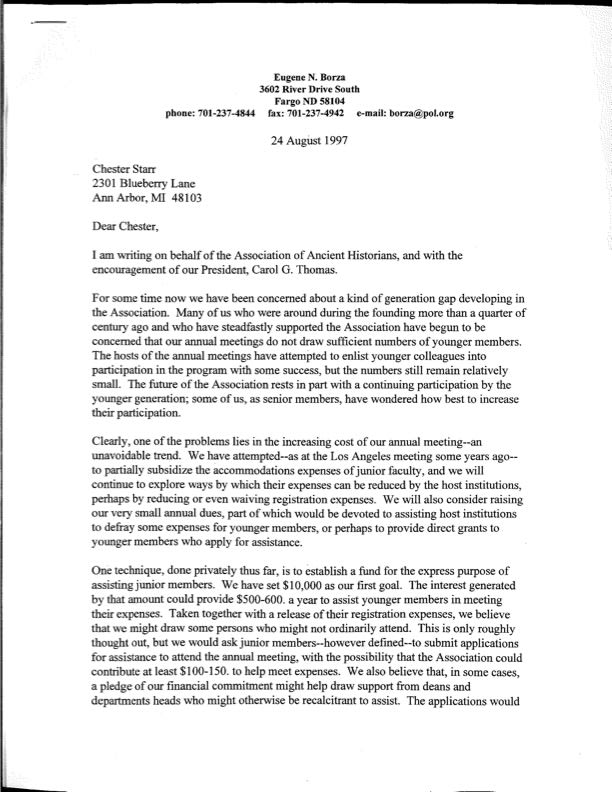
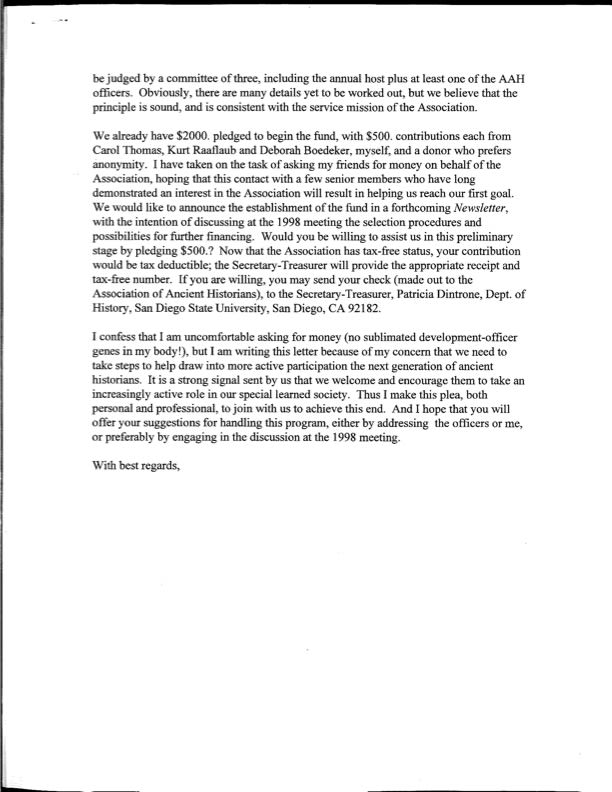
Eugene Borza sends out correspondence in 1997 to AAH members, like Chester Starr, to raise funding for the subvention fund.
Eugene Borza sends out correspondence in 1997 to AAH members, like Chester Starr, to raise funding for the subvention fund.
Eugene Borza sends out correspondences in 1997 to AAH members, like Chester Starr, to raise funding for the subvention fund.
Eugene Borza sends out correspondences in 1997 to AAH members, like Chester Starr, to raise funding for the subvention fund.
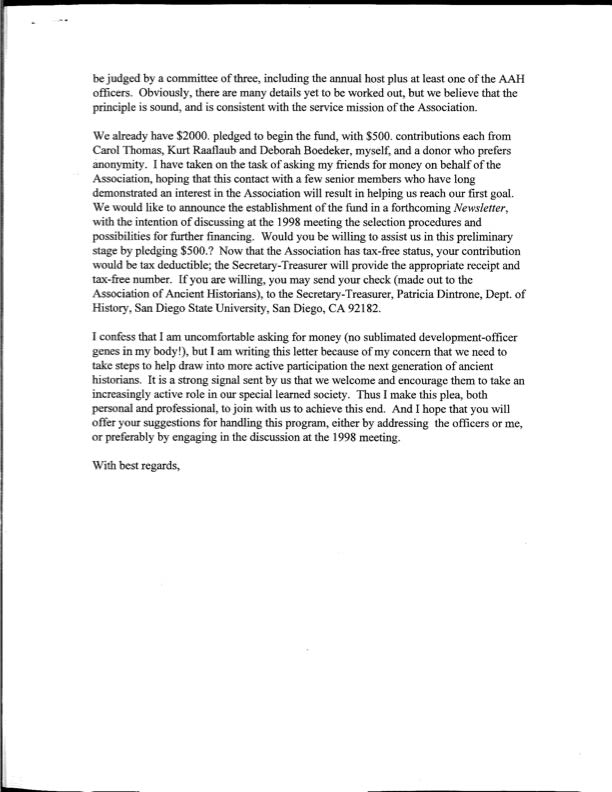
Eugene Borza sends out correspondences in 1997 to AAH members, like Chester Starr, to raise funding for the subvention fund.
Eugene Borza sends out correspondences in 1997 to AAH members, like Chester Starr, to raise funding for the subvention fund.
Eugene Borza sends out correspondences in 1997 to AAH members, like Chester Starr, to raise funding for the subvention fund.
Eugene Borza sends out correspondences in 1997 to AAH members, like Chester Starr, to raise funding for the subvention fund.
In 1997, Carol Thomas, then president of AAH, along with key AAH members Eugene Borza, Kurt Raaflaub, and Deborah Baedeker, and an anonymous donor helped to seed our subvention fund.
Soon after, in 1998, the AAH received a generous bequest from Betty Coate, a teacher and history enthusiast.
Thanks to this bequest, the seed funding, and subsequent donations from members, the AAH has been supporting scholars for over 25 years.
The annual Betty Coate Award and our Subvention Fund Awards have enabled recipients to present their research and attend our meetings, with most returning to our meetings year after year.
“I was hooked on AAH from my first conference. The speakers were fascinating and the questions were useful, but what sold me were the friends I made. People whose work I had admired for years were excited to talk to a random graduate student about his projects, because that’s the kind of interaction that AAH fosters and that its members believe in. As I went from graduate school to the VAP market to a tenure-track job, AAH introduced me to collaborators, recommenders, and even an outside reader; it’s been a fantastic home base for me in my discipline, but it’s also always the highlight of my year. AAH is where I see old friends and make new ones, it’s where I learn about exciting new research in ancient history, and it’s where I pay forward the kindness that ancient historians showed me when I was just starting. Join, and say hi.”
“Joining the AAH is one of the best professional decisions I have made. Since becoming a member I have been impressed by their efforts to aid junior faculty which range from a mentorship program to teaching resources. Moreover, I have benefited from their support of new members to attend and present at their annual conference and have been impressed by the quality and collegiality of these meetings and the opportunity they provide for networking in the field.”
Casey Stark notes how the Subvention Fund encourages new members to join the AAH and become long-lasting, active members in the association—just like Casey herself and other AAH officers.
In 2022, Eugene Borza generously gave the AAH a gift to establish a fund in his name: the Borza Publications Subvention Fund, which seeks to help defray members’ costs for publication expenses, a key goal for the organization in its next 50 years.
You can donate to the AAH Subvention Fund and the Borza Publications Subvention Fund here:
With a template for the meetings established and increasing participation each spring, the AAH looked for additional ways to engage members.



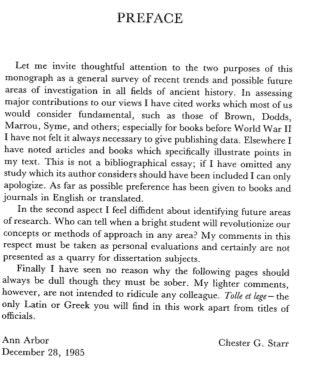
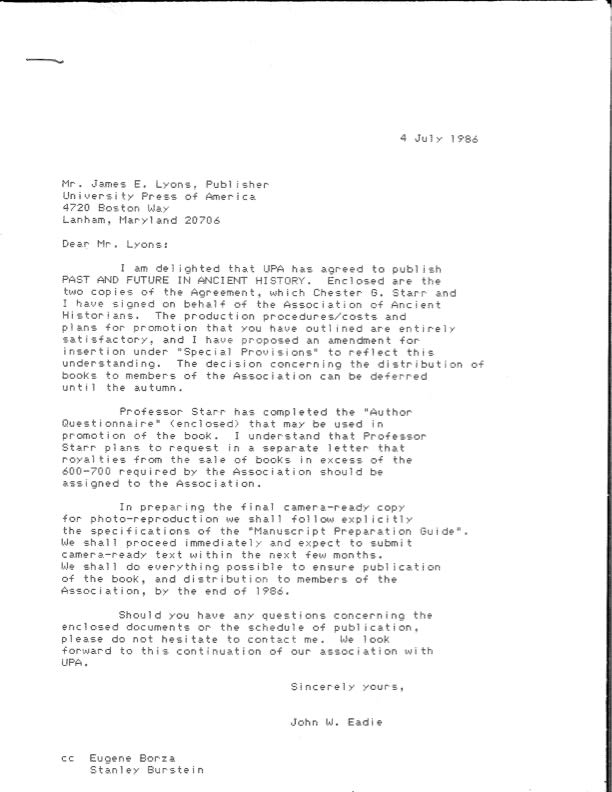
Preface to Chester G. Starr's "Past and Future in Ancient History," the first of the Publications of the Association of Ancient Historians (PAAH)
Preface to Chester G. Starr's "Past and Future in Ancient History," the first of the Publications of the Association of Ancient Historians (PAAH)
Preface to Chester G. Starr's "Past and Future in Ancient History," the first of the Publications of the Association of Ancient Historians (PAAH)
Preface to Chester G. Starr's "Past and Future in Ancient History," the first of the Publications of the Association of Ancient Historians (PAAH)
Preface to Chester G. Starr's "Past and Future in Ancient History," the first of the Publications of the Association of Ancient Historians (PAAH)
Preface to Chester G. Starr's "Past and Future in Ancient History," the first of the Publications of the Association of Ancient Historians (PAAH)
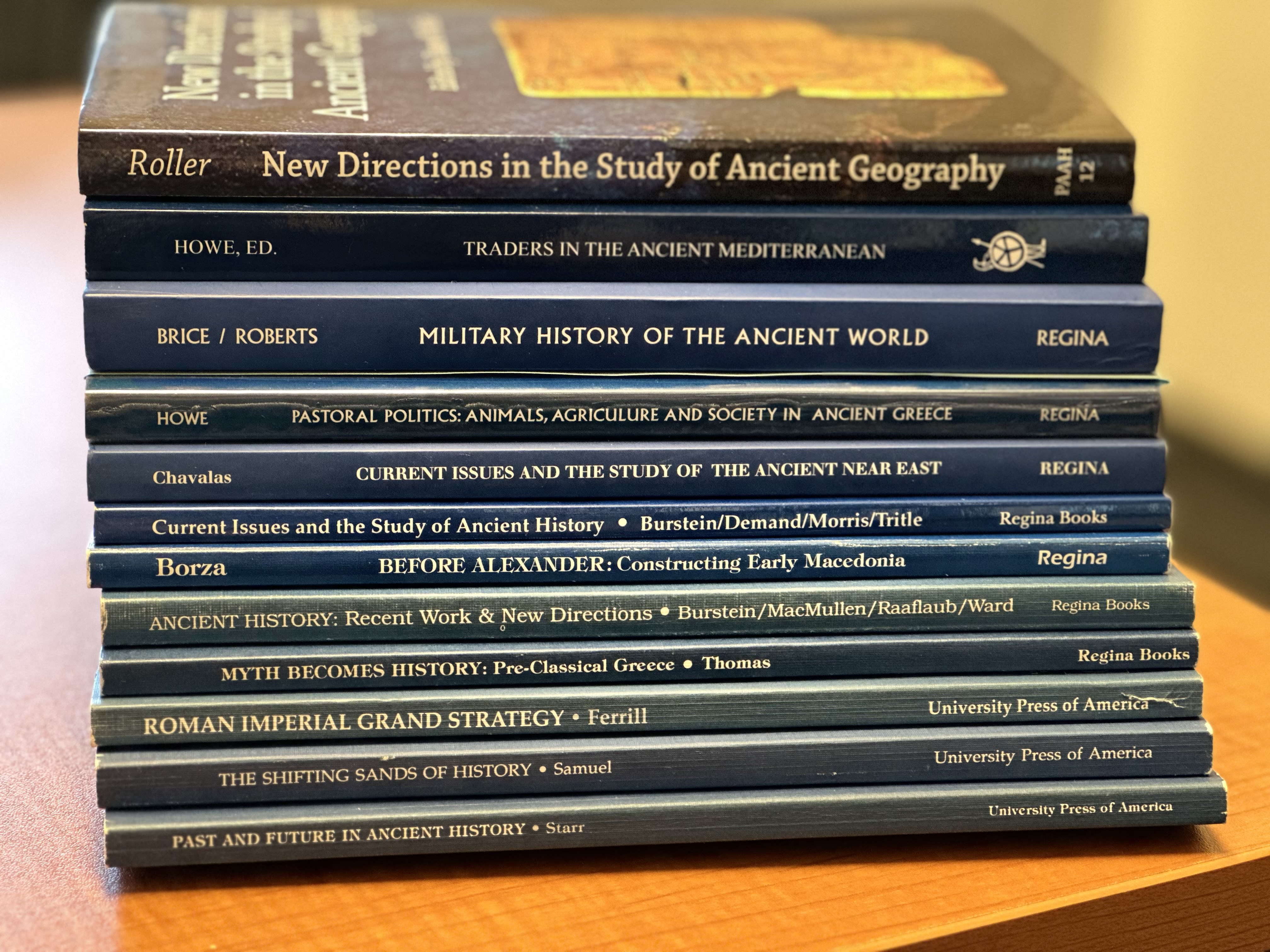
The Publications of the Association of Ancient Historians series was launched in 1987 with the intention of serving both the teaching and research missions of the AAH and is managed by the Publications Committee.
Our big thing was the annual meeting, which got around 100 members. All the remaining 600 got was the newsletter. And that was one of the inspirations for trying to do something for them that we could afford, that they would keep; give them the sense that they were getting something back for their membership.
The purpose of the PAAH series has been to provide members with brief introductions to key topics that they might be teaching or researching for the first time, as well as up-to-date and timely surveys of fields that have undergone significant change.
The twelve (thirteen by May 2024) volumes of the series have ranged across not only Greece and Rome, but the Ancient Near East as well, and members have benefited from the expertise of distinguished colleagues including Stanley Burstein (on Ptolemaic Egypt), Carol Thomas (prehistoric Greece), and Eugene Borza (Macedonia).
At the 1985 AAH meeting, the PAAH series was officially approved, leading to the Association's first president, Chester Starr, writing the initial volume in the series, published in 1987.

For the first 50 years of the AAH, members have received printed volumes. But as digital formats continue to improve and expand, we now have the opportunity to bring together text and images in innovative ways.
The AAH continues to seek ways to engage its members.
Committees on Diversity, Teaching, and Mentoring offer programming that meets the needs of ancient historians in the 2020s.

The Committee on Teaching supports a core mission of the AAH: to provide resources to college-level teachers at every stage of their career.
The Committee on Teaching formed in 2019 to serve AAH members active in the classroom. In its first year, the committee helped instructors transition to online and hybrid teaching during the onset of the COVID-19 pandemic. It has subsequently hosted annual fall workhops related to current teaching concerns of AAH members, such as how to create a welcoming syllabus and classroom for a diverse student population. The committee looks forward to continuing to serve the teaching needs of ancient historians, and it welcomes involvement and ideas from all AAH members. Stay tuned for news about upcoming events and initiatives!
The Committee on Diversity commits to the inclusion and awareness of various minority groups both in research and in the field.
Like any other discipline, ancient history is constantly evolving—our increasingly diverse membership deserves an organization that is aware of their needs and responsive to their particular approaches to both the field and the profession. Accordingly, AAH has established a Diversity Committee in order to bring the Association forward and better serve our community. In recent years the Committee has updated the AAH policies on harassment, put together programming on how marginalization impacts the research and teaching of ancient history, and worked with conference hosts to develop panels on subaltern historical subjects.
Recent programming has included a workshop on disability — both as experienced by our members and as a growing sub-discipline in our field.
The Mentorship Committee helps members navigate everyday professional challenges and their long-term careers with a growing peer- and co-mentoring program.
The Committee presents the annual Randall Howarth Award for Excellence in Mentoring to those who have done outstanding work in their role as a mentor to younger scholars.
The Grants and Awards Committee (formerly known as the Subvention Committee) assists junior members in attending our meetings and recognizes service to the AAH.
For more information, scroll up to Grants and Awards.
The Committee on Professional Conduct works to formulate the development of professional conduct for the AAH.
The Committee on Social Media and Technology:
This committee enables the AAH to serve the needs of members and engage with thousands of people worldwide who are interested in ancient Mediterranean history. The Committee maintains a website (currently undergoing a major makeover) and accounts on Facebook and X (formerly Twitter). Through these channels, AAH shares membership information, conference and organizational updates, and mission-related opportunities, including grant, conference, publication, job, fellowship, and study opportunities.
The Committee on Publications solicits proposals for PAAH volumes and supports them through the publication process.
The AAH warmly welcomes members to serve on these committees. Interested in serving?
Previous Panels Set Up by the AAH Committees:
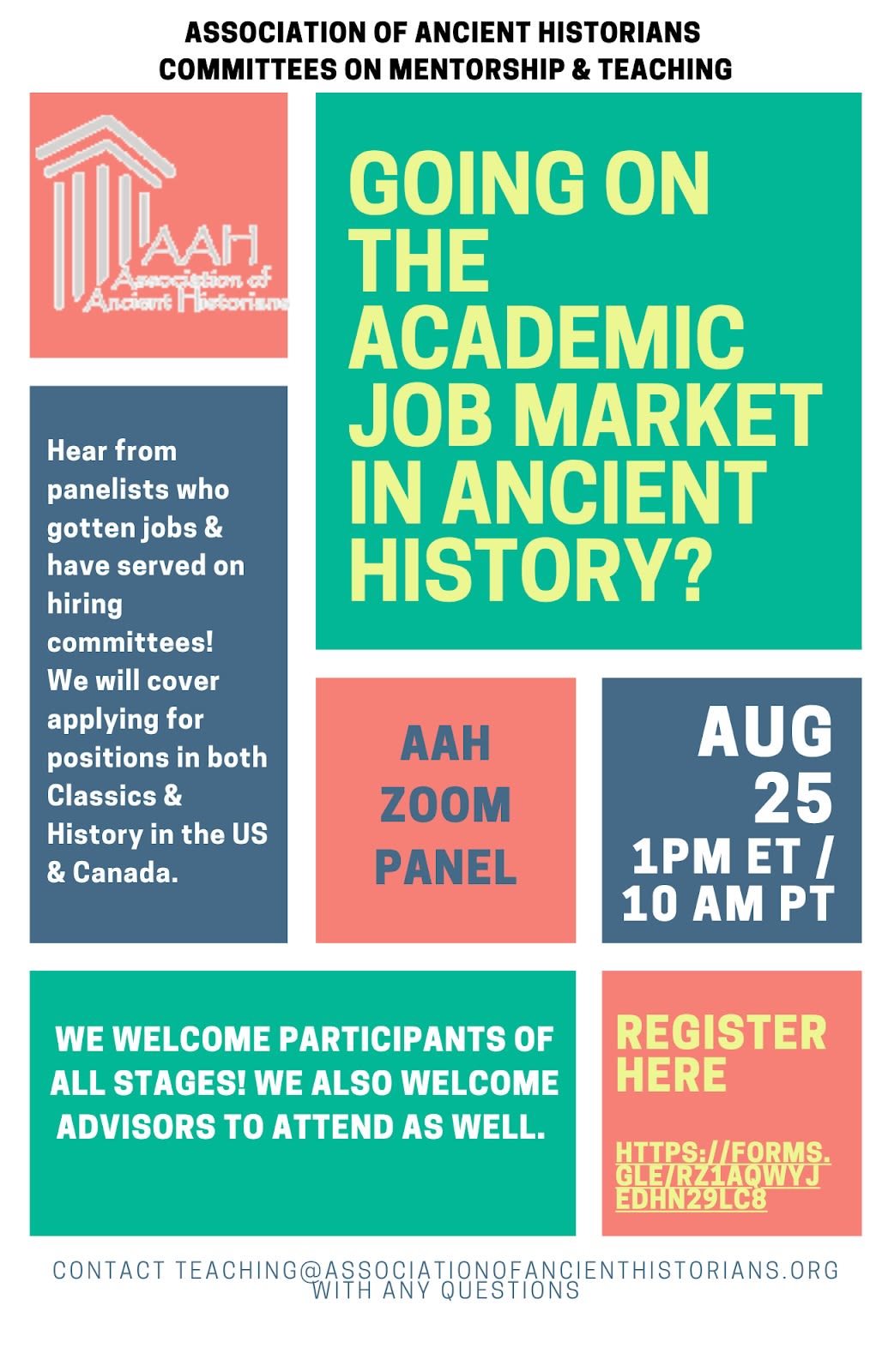
Going on the Academic Job Market in Ancient History (2023) [co-sponsored with the Mentorship Committee]

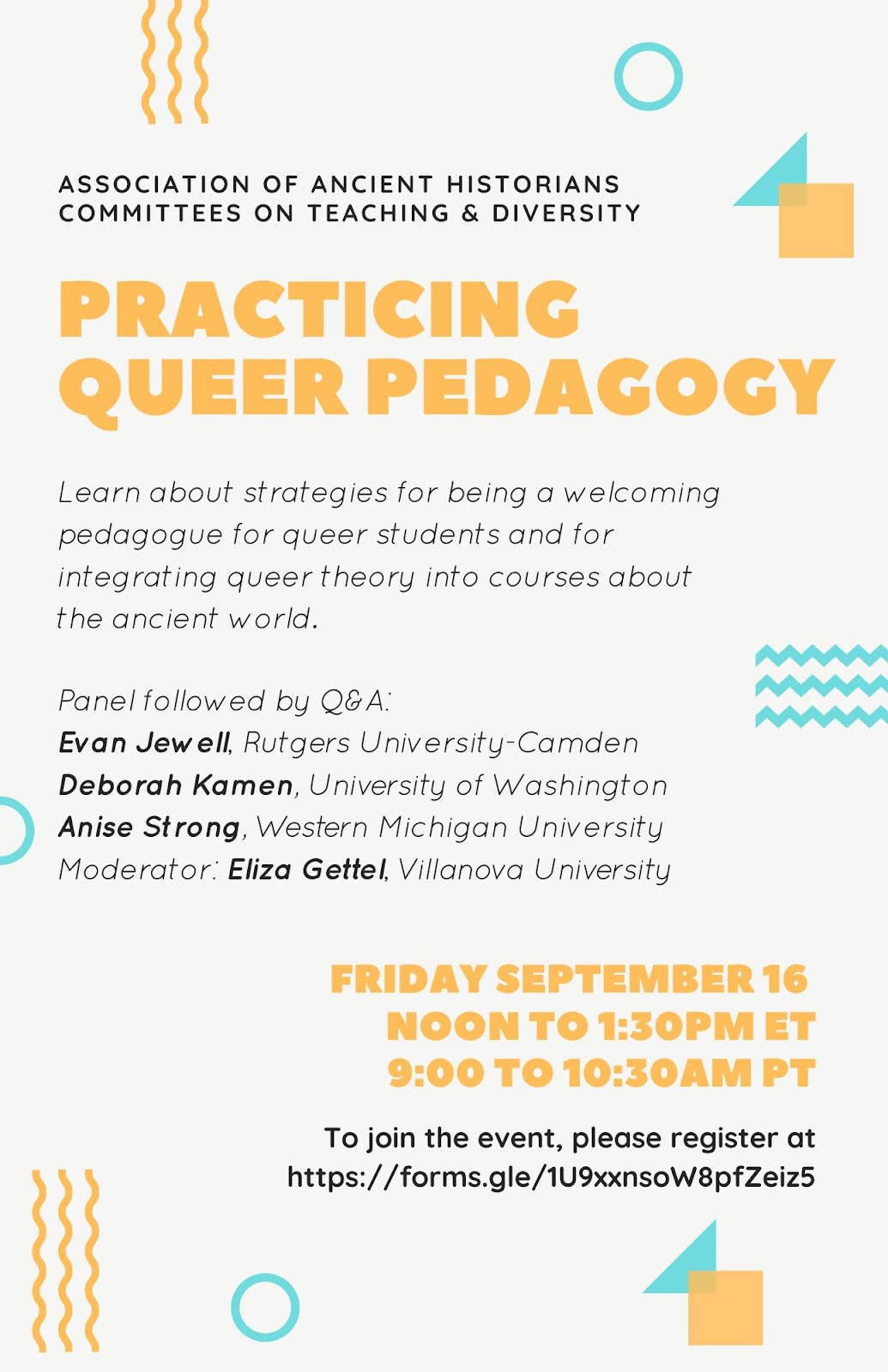
Practicing Queer Pedagogy (2022) [co-sponsored with Diversity Committee]

 Built with Shorthand